

The Advantages of USD Denominated Bonds for Companies
The world is becoming increasingly interconnected. Capital is abundant globally, and the importance of tapping foreign capital cannot be overstated.
Finding the required resources to engage in business has been a crucial obstacle for much of human history. The development of proper capital markets started in late medieval Europe, changing the world forever.1 Only after such development could the entrepreneurial spirit flourish, risks and rewards be shared.
This article discusses the benefits of raising capital in foreign currencies and tapping into international markets for local firms.
Benefits of Issuing Foreign Exchange-Denominated Bonds
Raising more funds from abroad is anticipated to offer several benefits. For borrowers, it provides an opportunity to diversify their funding sources. For lenders, it allows the distribution of risk assets that domestic financial institutions, particularly banks, predominantly hold.2
Not only do firms benefit from tapping global capital markets, but even governments with fragile economies require access to hard currencies. For nearly two decades, many sub-Saharan countries have utilized Eurobonds to finance infrastructure projects, address public finance imbalances, and refinance public debt. Globalization has streamlined cross-border investing, making international investors crucial in meeting these funding needs.
In most emerging countries, the corporate sector still relies heavily on international financial markets.3 Different companies choose Foreign Exchange (FX) Denominated bonds for various reasons depending on their industry, local currency with which they do business, and local regulations where they are located.
Import-dependent companies require FX for their operations, especially when their revenues are generated in local currencies. These companies tap global markets to meet their long-term FX demands efficiently; the supply of FX is not abundant in local markets, and even holding them is sometimes discouraged.
Regardless of the specific needs of a company, borrowing with local currencies might hurt the predictability of a company’s future performance if those currencies are volatile, as it is the case with most of emerging markets’.
Most importantly, local bond markets are too immature, especially in emerging markets. Unlike the bond markets of most advanced economies, they do not uphold a standardized investing environment aligned with international standards. For example, distortionary or unattractive tax treatment for bond investments can deter investors. Additionally, weaknesses in accounting and audit standards further reduce investor confidence. These issues discourage foreign investors, who are needed as the local investor base is often too narrow. The local bond markets are also highly illiquid and dominated by opaque OTC deals. Moreover, local regulations can be too stringent and time-consuming, whereas funds are raised faster in international markets.4 5
Offshore corporate bonds typically fall under distinct and more lenient regulatory regimes. For example, in India, these bonds are governed by the relatively straightforward external commercial borrowings (ECB) framework. Additionally, local firms can issue Foreign Currency Convertible Bonds (FCCBs), which allow lenders to convert debt into equity. These FCCBs are even more attractive as they fall under favorable foreign direct investment (FDI) regulations. This regulatory advantage makes FCCBs particularly popular among Indian firms.6
1 - https://www.thinkadvisor.com/2009/02/01/the-earliest-securities-markets/
2 - Institute for International Monetary Affairs, "The Bond Market in India", March 2020
Is FX Bond the Same as Offshore Bond?
FX bonds and offshore bonds are often used interchangeably, causing confusion to most. Actually, they have subtle differences that shed light on important aspects of the global bond markets.
When a company or government issues a bond in a currency other than its domestic currency, it is referred to as a foreign exchange-denominated bond. Alternatively, a bond issued in a market outside of the issuer's home country is termed an offshore bond, distinguishing it from an onshore bond issued within the domestic market.
Hence, not all offshore bonds are FX bonds, and vice versa. For example, in India, when the rupee collapsed against the USD from 2011 to 2013, there was still a high demand for borrowing from abroad. However, borrowing costs in foreign exchange had soared. Therefore, the government created the International Finance Corporation (IFC) to facilitate rupee-denominated offshore bond issuance.7
Another term for offshore bonds is “Eurobond”, which encompasses all types of offshore bonds, regardless of their currency denomination. However, specific names are also assigned to offshore bonds based on their issuance locations, such as Samurai Bonds in Japan, Kiwi Bonds in New Zealand, Kangaroo Bonds in Australia, Dim Sum Bonds in Hong Kong, Formosa Bonds in Taiwan, Panda Bonds in mainland China, and Yankee Bonds in the USA. These bonds are typically denominated in the local currency of the issuance location.
However developed these markets are, their mere existence suggests access and liquidity fragmentation problems that would not exist on a global onchain bond protocol.
Currency Preference by FX Bond Issuers
Indian firms' aforementioned rupee-denominated offshore bonds are examples of offshore bonds that are not FX bonds. According to a dataset covering 7831 firms in 34 major emerging markets and seven advanced economies from 2000 to 2015, only 14% of offshore issuance is in local currencies. Conversely, 3% of onshore issuances are denominated in foreign currencies, primarily US dollars.8
Foreign exchange denominated offshore bonds follow the same pattern as FX onshore bonds, predominantly being in US dollars.
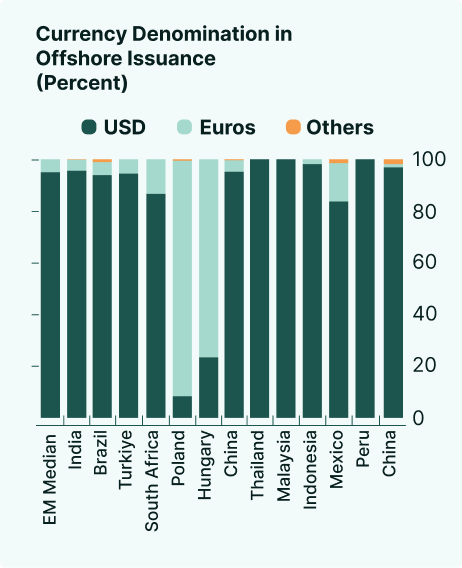
The dollar-denominated offshore bonds dominate the US and EU markets, accounting for 91% and 51% of the total, respectively. In the EU market, where the average is 51%, this proportion rises to 74% for issuances by firms from emerging economies and falls to 20% for issuances by firms from advanced economies.9
7 - Institute for International Monetary Affairs, "The Bond Market in India", March 2020
Demand for FX Bonds
In the aforementioned database, only 2305 firms out of 7831 are offshore issuers, yet 49% of total debt is offshore and 51% onshore. Strikingly, firms issuing only onshore account for just 26% of total debt issued, highlighting the growing reliance on offshore markets for raising capital.10
The issuance of offshore bonds surged dramatically following the Great Financial Crisis (GFC), particularly in emerging markets that lack hard currencies, such as those in Latin America. When conditions are favorable, bond funding becomes more advantageous than bank loans for many corporations. Post-GFC quantitative easing policies implemented by the world’s central banks created a supportive macroeconomic environment, making bond financing especially appealing. In some regions, bond issuance has even outpaced cross-border bank lending.11
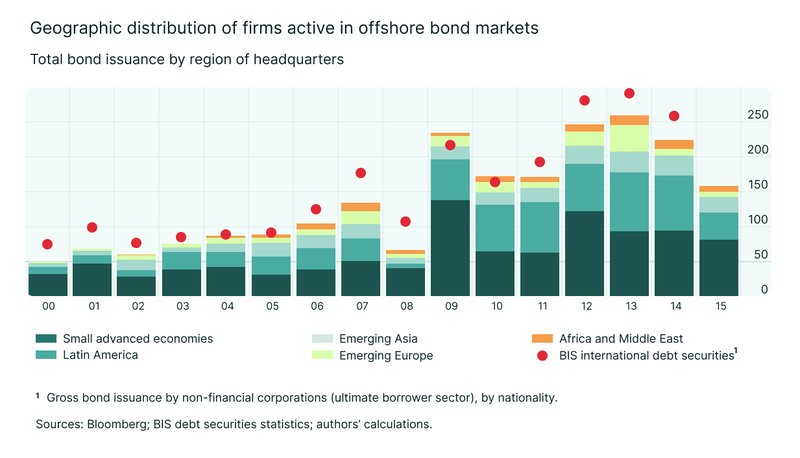
Despite having the highest number of firms active in offshore bond markets, with nearly 1,000 firms and the second-highest number of issued bonds (2,057), emerging Asia is significantly outpaced by Latin America in terms of total debt value. Between 2000 and 2015, Latin American firms have issued $639 billion in debt, compared to $273 billion from Asian firms.12
Actually, this discrepancy demonstrates the demand for offshore issuance across firms of all sizes, driven by different reasons such as finding a more risk-tolerant investor base, avoiding local regulatory hurdles and overcoming unpredictability.
In most emerging markets—such as Brazil, Mexico, Peru, and Turkey—large corporations issue bonds in offshore markets to hedge against economic volatility and local currency instability. These challenges often limit smaller firms’ access to international bond markets. In contrast, in more economically stable markets like India, China, Malaysia, and Thailand, the largest corporations often issue bonds in local currencies. Offshore issuance in these regions is more characteristic of smaller firms, often with lower credit ratings, that seek better-borrowing terms and attract FX bond investors interested in higher yields.13
However, policy is not very supportive of FX bond issuance in many emerging Asian markets discussed above, limiting the exchange rate and discouraging dollarization to prevent national balance sheet risks. Nevertheless, with globalization and quantitative easing post-GFC, offshore borrowing has been on the rise. For instance, In India, despite having the ECB framework and other regulatory easements that facilitate hassle-free FX bond issuance, there is a nominal limit on how much can be borrowed through the ECB. Yet, offshore issuance rose 50% from 2012 to 2021 to a record pace.14
With quantitative tapering post-COVID, offshore issuances have been more subdued between 2022 and 2023 in emerging markets, especially in Asia where they dropped to a 14-year low in India. However, with the expectation of rates decreasing and macroeconomic conditions stabilizing, lenders' risk appetite has been growing. CitiGroup anticipates nearly record-breaking dollar-denominated bond issuance in India in 2024, with 30% to 35% expected to be high yield, capitalizing on investor appetite.15
Efforts to Increase Access
But not all policies are disincentivizing. Some countries are making efforts to open up FX bond markets and reduce barriers. For instance, Malaysia exempts resident investors from income tax on profits from foreign currency-denominated sukuk, encouraging broader participation. Similarly, the Philippines launched Multicurrency Retail Treasury Bonds in 2010, with an affordable minimum denomination, which helps attract private investors and positively impacts borrowing costs.
These policies demonstrate how certain governments are gradually making FX bonds more accessible despite some countries’ limitations on exchange rates and the push to avoid dollarization.
Conclusion
Bondi Finance envisions a global bond marketplace with unified rules, removing barriers that have traditionally kept firms and investors locked within local, less-liquid markets. We open the door to international investors seeking stable and high returns by providing access to this globalized marketplace.
Bondi enhances market access and democratizes the process, enabling firms from emerging markets to tap into a global investor base without the friction of traditional financial systems. As we continue to buidl, our mission is clear: to offer a seamless, borderless, and efficient capital market that bridges gaps and connects investors with opportunities worldwide.
More from the blog.
All posts
The Reinvestment Vault: How coupons become more bonds
Coupons are the whole point of a bond and the one thing DeFi cannot handle. The Reinvestment Vault keeps the Bond Token a full bond underneath and puts a clean, compounding ERC-20 share on top:…

Introducing the Redemption Vault: From request to cash
A Bond Token keeps everything a bond does, so its exit has to handle everything a bond does. The Redemption Vault gathers exits of any size into one real bond sale through the regulated custody…

Introducing v3: Every change to the Bondi core, and why
Bondi v3 is built on the v2 contracts and closes the gap between a token that pays coupons and a bond: calls, amortizations, a supply that grows, fees taken onchain, proceeds that never pass through…