

Financial Inclusion and the Role of Tokenized Bonds
When retail investors are provided with the tools of financial inclusion, they provide invaluable liquidity to debt markets and become a key driver of economic development. Tokenization is a great opportunity to increase financial inclusion and drive growth.
Financial Inclusion essentially refers to the general accessibility of financial services and products. It is considered as one of the fundamental prospects of evaluating a nation’s level of economic development. The full definition according to the World Bank is “Having access to affordable and useful financial products and services to meet the needs of transactions, payments, savings, credits, and insurance delivered in a sustainable and responsible manner”.
Thus, the primary step of achieving financial inclusion is to provide the general population with means to connect to financial institutions, such as bank or brokerage accounts. Apart from the quantifiable positive effects that financial inclusion has on those who are the primary beneficiaries of said inclusion, namely retail investors, it also generates a positive feedback loop in the financial system. To be more precise, developments toward financial inclusion in a financial system attract more retail investors which results in more growth and further developments. As the system grows and develops, it attracts capital flows not only from retail investors who are the primary beneficiaries of the developments but from domestic, and international institutional investors. Notably, improvements, particularly in banking services and credit availability, foster economic environments conducive to foreign capital influx.
Traditional & Tokenized Bonds
A strong debt market, with a balanced distribution between bank loans and bonds, is crucial for a cohesive and strong financial system. When a large corporate bond market is established, it allows the free market to play a larger role in the debt market, which helps in lowering systemic risk and preventing financial crises. This environment promotes better accounting transparency, a strong network of financial analysts, credible rating agencies, and a variety of corporate debt instruments and derivatives that require credit analysis. It also ensures efficient processes for corporate restructuring and liquidation. All these mechanisms, born out of necessity for the efficient working of bond markets, naturally result in the growth of the financial system. 1
Tokenized bonds represent a significant leap forward for bond markets, using blockchain technology to increase the efficiency of traditional bond issuance and trading processes. By converting a bond into tokens on a blockchain, tokenized bonds introduce various advantages over conventional bonds. Along with tokenizing existing bonds, new bonds can be issued on a blockchain. Being able to tokenize existing bonds provides a significant advantage in accelerating the transformation of the bond market into the digital realm.
To both tokenize an existing bond and issue a new bond on-chain, a token representing the bond is created. Thanks to already available legal frameworks in some countries, an ISIN code can be assigned to a tokenized bond, giving it solid legal backing. After the tokens are minted, various methods can be used to allow the investors to receive coupon payments and principal repayment at maturity. These can include functions embedded in the token or the use of smart contracts which would require the token holder to interact with them to automate the processes. This greatly reduces the need for manual paperwork and the involvement of intermediaries.
Empirical Evidence
How Financial Inclusion Benefits Bond Markets
Analyzing data from 35 countries over 19 years, Ofosu-Mensah Ababio, et al (2023) reveal that financial inclusion significantly contributes to the development of financial systems, particularly debt markets.
Key findings show that financial inclusion indicators such as the number of bank accounts per adult, borrowing activity per adult, ATM availability, and remittances are strongly associated with increased debt market depth. This means that greater access to financial services enhances the value and size of the bond market by increasing participation and liquidity. 2
How Tokenization Benefits Bond Markets
The primary advantage tokenized bonds present to the existing bond markets is the democratization of the sector as a whole. The exponential increase in efficiency for all processes makes the asset class more desirable for investors and debt issuers alike.
Underwriting Fees
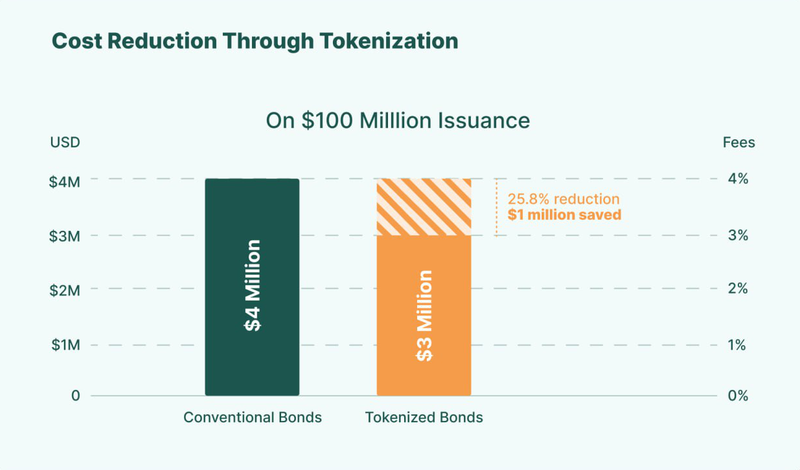
Financial institutions that facilitate the issuance of securities such as bonds charge fees for the services they provide. Since the magnitude of legal and operational work required to market and sell the bonds to investors is very high, it tends to be an expensive endeavour for the issuer. So much so, the fees can be up to 4%, which represents a significant cut to the final amount that the issuer will receive. 3
Tokenized bonds reduce underwriting fees by 25.8%. On a $100 million issuance, a cost reduction of these proportions would save the borrower up to $1 million, which could be used for investment purposes instead.
Yield Spreads
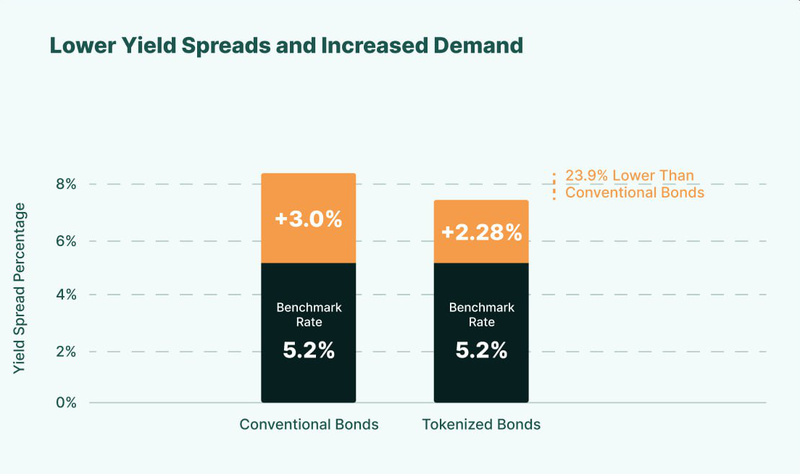
When compared to benchmark rates, the yield spreads of tokenized bonds compared to their traditional counterparts are 23.9% lower. Having less interest costs throughout the life cycle of a help bond issuers save great sums. Lower yield spreads for the same asset class highlights the desirability of tokenized bonds. On-chain investment processes happen with less friction compared to traditional ones, resulting in increased investor demand. All in all, investors are fine with getting less returns because it’s simply easier to invest in tokenized bonds.
Liquidity & Price Discovery
A major problem in bond markets is the illiquidity of secondary markets. This problem is amplified for emerging market bonds. From a dataset of 4,591 corporate bonds from countries in the MSCI Emerging Markets Index, denominated in US Dollars, 3,909 of them, which equals 85.1% of these bonds, have minimum settlement values exceeding $100,000. 4
4 - Data taken from cbonds.com “Bond Screener”
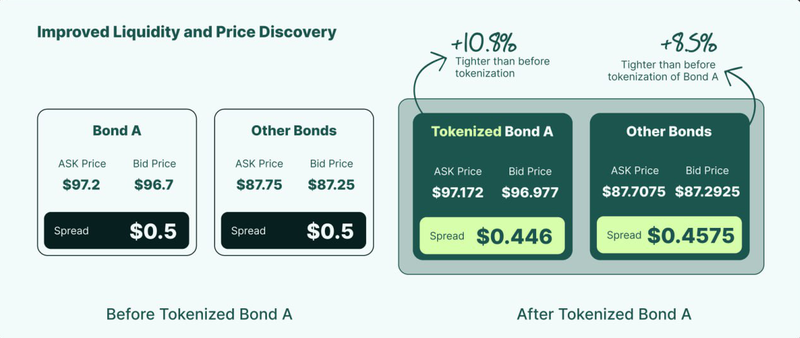
There are two ways in which tokenization benefits the liquidity of bond markets. First, the increased accessibility results in tighter bid-ask spreads in order book style markets. Specifically, when a tokenized bond is made available to retail investors, the bid-ask spread tightens to 10.8%. A contribution made by tokenized bond markets to traditional markets is that the order book spreads of similar conventional bonds are observed to be 8.5% tighter, improving the price discovery of the assets.
Second, tokenization allows the bonds to be traded in AMM (Automated Market Maker)-style markets. AMMs ensure liquidity at all times by relying on liquidity providers instead of Ask or Bid side investors. When there is enough liquidity in the market, AMMs ensure that the price of the asset is accurate to its value and allow investors to trade without having to rely on limit orders.
Decentralization & Custody
Traditionally, when an investor buys a bond via a financial broker, the brokerage facilitates the market to buy the bonds and holds the custody of the assets on its customers’ behalf. This practice limits the ability of asset holders’ to use their bonds to make financial moves like collateralizing their asset so take loans and such.
While it is true that the brokerage who holds the custody can provide loan options or the investors can go to other financial institutions to collateralize their assets, this process involves either accepting the terms provided by the original broker or shopping around for other institutions to accept the bonds as collateral. Even then, bonds under a certain credit rating can be seen as too risky and denied to be used as collateral.
Tokenization gives investors full control over their assets and allows them to utilize them for different purposes on-chain. Instead of having to rely on the collateralization conditions of few institutions, DeFi empowers bond owners to put their assets to work rather than having them sit idle.
Conclusion
Allowing the masses to participate in financial markets, in this case debt markets by enhancing and increasing methods of financial inclusion benefits the whole economy. Deeper and more varied debt markets improve the quality of life of average people and enable firms to access capital easier and cheaper. The emergence of tokenized bonds represents a significant advancement for financial markets, providing greater accessibility, efficiency, and inclusivity.
Tokenization opens investment opportunities to a broader range of investors, including those who previously lacked access. Bondi aims to be a flag bearer in the democratization of finance and allow masses to easily invest in bonds. Instead of simply minting Bond Tokens and stopping there, our platform provides mechanisms to carry all functions of traditional bonds on-chain, with the added benefits that blockchain technology offers to users. Financial inclusion is a crucial part of advancing economies and therefore societies, and tokenization is a perfect tool to achieve it.
More from the blog.
All posts
The Reinvestment Vault: How coupons become more bonds
Coupons are the whole point of a bond and the one thing DeFi cannot handle. The Reinvestment Vault keeps the Bond Token a full bond underneath and puts a clean, compounding ERC-20 share on top:…
Introducing the Redemption Vault: From request to cash
A Bond Token keeps everything a bond does, so its exit has to handle everything a bond does. The Redemption Vault gathers exits of any size into one real bond sale through the regulated custody…

Introducing v3: Every change to the Bondi core, and why
Bondi v3 is built on the v2 contracts and closes the gap between a token that pays coupons and a bond: calls, amortizations, a supply that grows, fees taken onchain, proceeds that never pass through…