

The Role of Foreign Investors in Strengthening Capital Markets
One of the main characteristics of our age is the globalization and democratization of financial markets, enabling investors to invest in security markets from an ocean away. This article discusses how participation by foreign investors can help strengthening the debt market.

Foreign Investors’ Response to Globalization and Macroeconomic Dynamics
Analyzing the trends in the behaviour of foreign investors in government securities in the last two decades sheds light on understanding their potential behaviour in overall debt markets in the increasingly globalized future with likely crises.
Due to globalization, the share of non-resident investors in government securities has been increasing for the last two decades.1 However, foreign investors tend to reduce their holdings during times of crisis. Their holding share lagged after 2007 for some time as investors became risk-averse but then continued its increasing trend until the Covid-19 crisis, after which the trends seemed to diverge for individual countries and lag again for some.2
Following the Great Financial Crisis, the increase in the share of foreign holders in the US, UK, and Japan was driven by quantitative easing policies, which helped restore trust in the economy.
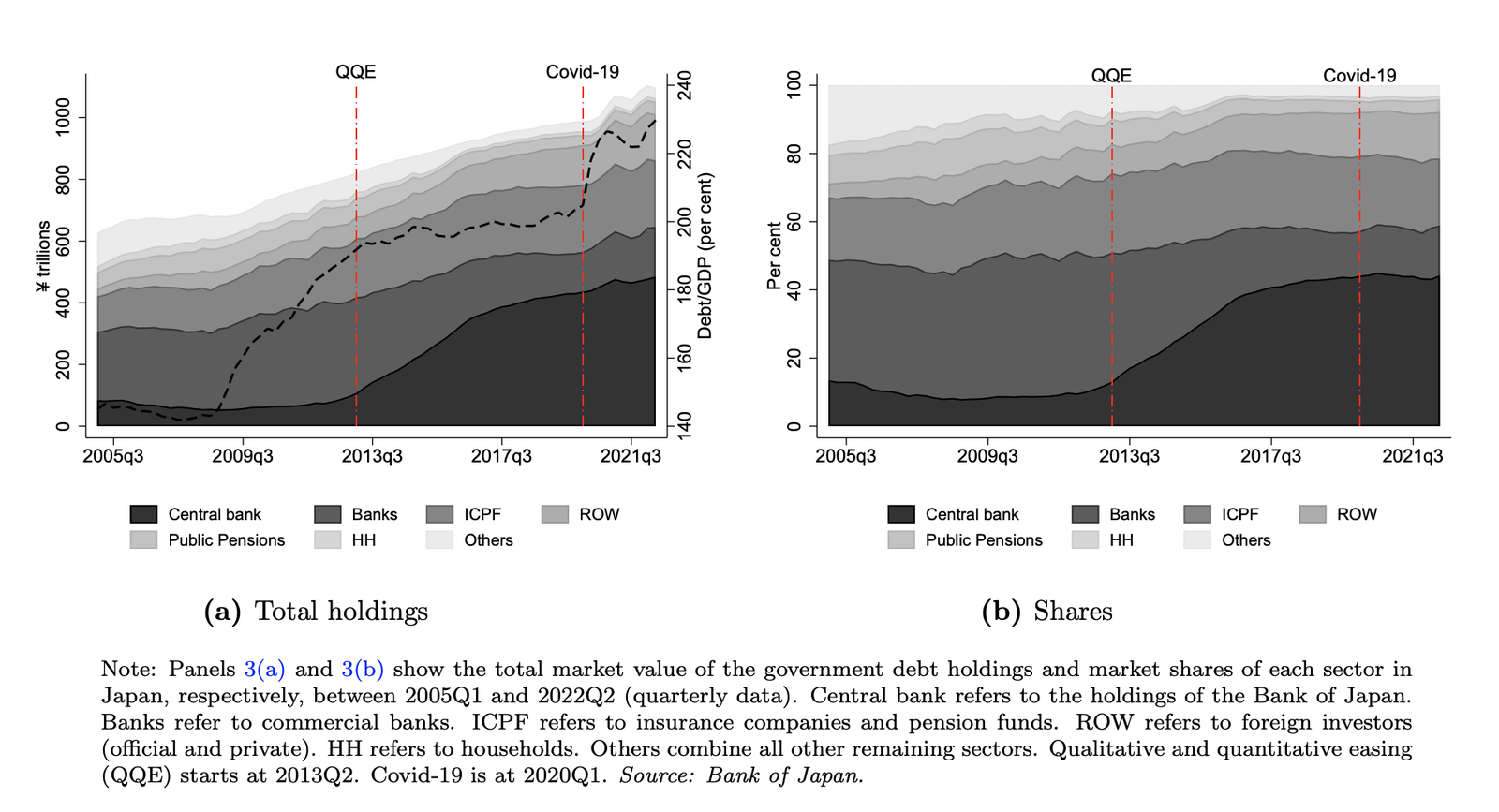
In the US, the foreign investor share increased from 14.4% at the beginning of the sample period to a peak of 40.6% after 2009, only to decline to around 30.4% following the Covid-19 crisis. Meanwhile, the Euro Area has seen a stable foreign investor share of around 45%, though marginal absorption declined with quantitative easing in 2014 as central banks became the primary absorber of debt.3
Starting in 2022, central banks implemented quantitative tapering policies by raising rates and shrinking their balance sheets. In 2023, rates continued to rise as central banks aimed to combat inflation. By 2024, rate hikes paused, with central banks maintaining stable rates for some time before carefully beginning to lower them. Despite these rate cuts, balance sheet reductions have continued.
Given that central banks keep intending to contract their balance sheets and keep rates higher than their post-great financial crisis lows for a longer than expected period of time, it is curious how foreign investors will react.
According to a research paper written by the Bank of International Settlement, a quantitative tapering of $215 billion by the US central bank would mostly be absorbed by foreign investors at a market-clearing change of 10 basis points in the 8-year yield. Similarly, for the Euro area, a tapering of €188 billion would lead to a market-clearing change of 10 basis points in long-term yields, mostly being absorbed by foreign investors.4
Consequently, given that no other crisis occurs and tapering continues with expectations of future rate cuts leading to risk-on sentiment, it is expected that foreign investors will keep profiting from a higher yield relative to the quantitative easing era post-great financial crisis.
Positive Effects of Foreign Investors
The presence of foreign investors in any segment of the capital markets of an economy makes a significant difference in the growth of that segment, expanding the demand base for any security. The Indian equity market exemplifies how foreign flows can affect the capital markets of a country. Foreign investors’ interest and their exposure in the Indian equity market have led India to reach one of the top ranks worldwide in its equity market.5
Foreign investors have provided a significant development stimulus to numerous markets. Even though they are frequently seen as a source of funding, foreign investors frequently act as catalysts for more significant advancements.
Foreign investors can benefit the capital markets in the following ways:
- Expanding the demand base
- Boosting demand for longer-maturity instruments
- Providing liquidity
- Strengthening the legal framework and infrastructure
- Smoothing out laws that undermine competition
Foreign investors behave in stark contrast to domestic investors. They are extremely sensitive to fiscal policies, regulatory restrictions, efficiency of the market in terms of pricing and settlements, and availability of hedging instruments.6 Therefore, in order to encourage or keep foreign investors, countries commit more to developing their capital market infrastructure.
According to Asonuma et al. (2015), the phenomenon of "home bias”, domestic banks holding more of domestic sovereign debt than their international counterparts, may be linked to less adaptive fiscal policies or increased borrowing costs during periods of crisis.7
Addressing laws that undermine competition is imperative for all countries to ensure that their domestic capital markets are competitive to attract foreign investment. This includes adhering to international principles or even undercutting them regarding withholding taxes and taxes on capital gains to remain competitive with international capital markets.
The provision of liquidity is especially quintessential in underdeveloped regions. Africa, being the world’s least developed region, could benefit significantly from increased foreign investor participation as the limited investor base in African markets results in insufficient funds circulating to generate transaction activity in both the secondary and primary markets.8
Unfortunately, the development of capital markets is similar to the development level of individual countries.
Differences between Advanced Economies and Emerging Markets
Analyzing the market structure of advanced economies can be a great guide to deciding on how to shape developing economies.
Deep capital markets are essential for a country's prosperity, distinguishing advanced economies from emerging and underdeveloped ones. Deep markets have a healthy and balanced mix of equity and debt markets; also, their debt markets consist of instruments of various complexities, crucially presenting well-balanced corporate and government bond markets. Moreover, accessibility to a diverse range of investors—from pension funds to retail and foreign investors—is a key feature.9
In this article, we focus on the share of foreign ownership, but for a more comprehensive discussion on financial depth disparities, read our previous article, "Market Structure and Financial Depth Disparities Among Countries."
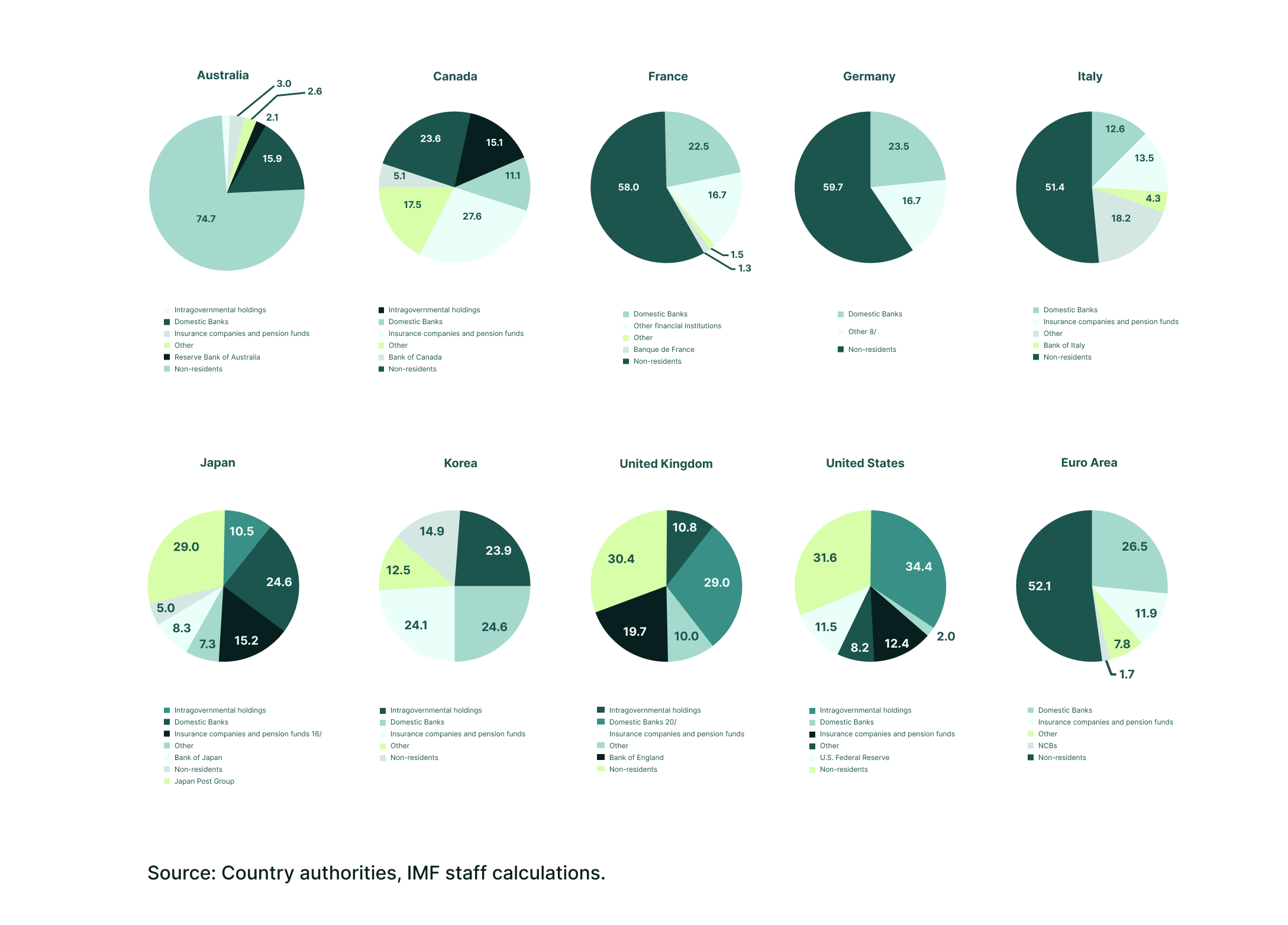
Below, Figure 2 shows the composition of the investor base of government securities for 2011 or thes latest period available. The pie charts illustrate the high share of non-resident foreign investors and the diverse investor base in advanced economies while reflecting specific regional and country characteristics.
In addition to their significant ownership of government bonds, foreign investors also hold a substantial share of corporate bonds in most advanced economies.
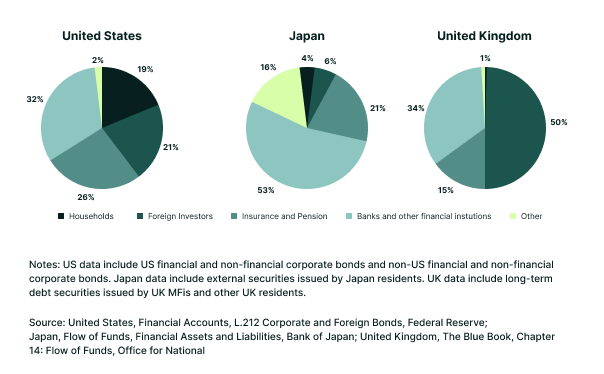
Foreign investors hold 21% of corporate bonds in the US, while an astonishing 50% of corporate bonds issued by UK companies were owned by non-UK investors by the end of 2013.10
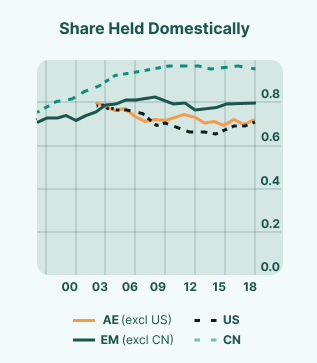
Emerging and undeveloped markets often have lower foreign investor participation because of information asymmetry, regulatory obstacles, and perceived dangers. Furthermore, underdeveloped countries cannot attract international investors due to issues like currency fluctuations and liquidity limitations. Figure 4 below shows that the share of foreign investors in government bonds is approximately 15% higher in advanced economies in comparison to emerging markets.
However, there are notable country-specific variations. For instance, in 2012, foreign investors held a 26% share of government bonds and an 8% share of corporate bonds in India. In Thailand during the same year, foreign investors accounted for a 12% share of government bonds.11
Policy Support and Disincentives
To address the share of foreign holdings disparity between advanced economies and emerging and developing economies, many countries have implemented favorable policies.
As foreign investors are highly sensitive to taxes, fiscal policy plays a crucial role. In 2012, Turkey lowered the withholding tax on interest income and the capital gains tax from corporate bonds to zero percent.12
Similarly, India recognized the importance of foreign investors in its market. By 2015, the investment limit for Foreign Portfolio Investors (FPIs) had been raised to $51 billion and withholding tax rates reduced from 20% to 5% Governor of the Reserve Bank of India emphasizing the importance of foreign investors.13
Nevertheless, certain difficulties still exist in spite of these efforts. In India, for example, while there has been a significant inflow of Foreign Institutional Investor (FII) funds into the equity market, such flow to the corporate bond market has been impeded by regulatory constraints, such as sub-limits and greater limits on FII investments. Addressing these regulatory barriers and promoting market efficiency could further broaden the investor base in India.14
On the other hand, not all countries are convinced that the benefits of foreign capital flows outweigh the potential risks. Some evidence indicates that a significant presence of foreign investors in capital markets can elevate yield volatility, exchange rate fluctuations, and the transmission of global shocks, particularly affecting underdeveloped markets.15
Foreign capital flows can also cause currency appreciation, therefore lowering the competitiveness of exports in international markets while simultaneously making imports relatively cheaper. Countries like Brazil, Chile, Indonesia, and Thailand adopted unfavourable policies like reintroducing withholding tax on interest income on bonds for foreign investors in 2012.16
Conclusion
Regardless of the policies in place, foreign demand for investment is undeniable. The data presented throughout this article highlights a clear trend of globalization. Investors are increasingly seeking opportunities beyond their domestic markets, and the demand to invest abroad is stronger than ever. This shift underscores the growing interconnectedness of global financial markets and the increasing importance of cross-border capital flows.
At Bondi, we envision a global marketplace where investors from all corners of the world participate under unified rules. Our focus begins with emerging market corporate bonds, which have historically been inaccessible, but our aspirations extend well beyond this initial offering.
Let’s contribute to the resilience and growth of the global economy together!
More from the blog.
All posts
The Reinvestment Vault: How coupons become more bonds
Coupons are the whole point of a bond and the one thing DeFi cannot handle. The Reinvestment Vault keeps the Bond Token a full bond underneath and puts a clean, compounding ERC-20 share on top:…

Introducing the Redemption Vault: From request to cash
A Bond Token keeps everything a bond does, so its exit has to handle everything a bond does. The Redemption Vault gathers exits of any size into one real bond sale through the regulated custody…

Introducing v3: Every change to the Bondi core, and why
Bondi v3 is built on the v2 contracts and closes the gap between a token that pays coupons and a bond: calls, amortizations, a supply that grows, fees taken onchain, proceeds that never pass through…