

Market Structure and Financial Depth Disparities Among Countries
From the dawn of history until the modern era, productivity growth barely surpassed population growth. Kings and emperors could only expand their land and wealth at the expense of either their subjects or other conquered people; conquests were financed by former plunders or by levying heavy taxes on the populace. The development of capital markets from the late medieval period sparked a significant shift, setting the stage for unprecedented disparities between nations that developed capital markets and those that did not.
Comparison between Equity Markets and Debt Markets
The equity market, also known as the stock market, enables investors to buy equity in publicly traded companies, whereas the debt market enables investors to lend out money in return for an interest. Even though the debt market consists of many complicated instruments, such as collateralized debt obligations (CDOs) and asset-backed securities like mortgage-backed securities, it generally refers to the bonds issued by governments or businesses paying a fixed amount of interest.
Both markets are essential for a healthy economy. In our first article, "Exploring the Bond Market", we thoroughly discussed the importance of bonds for both governments and corporations.
Yet, equity markets and debt markets are inherently different. Equity investments have a higher level of risk. Investors' capital is not guaranteed, nor are there any regular payments. In contrast to equity investors who invest in a probable prospective capital appreciation, bond investors are certain of getting fixed income and their principal upon bond maturity provided the company does not default on its debt, filing for bankruptcy. Additionally, bond holders have priority over stock investors in the event of bankruptcy.
Deep capital markets are essential for a country to prosper, and they are defined by a well-balanced mix of debt and equity markets and accessibility for investors of all types, from retail to pension funds. Currently, the global bond market is a sizeable portion of the global debt securities market and it stood around $100 trillion in 2023, similar in size to both global equity markets and the global GDP.1
Unfortunately, the composition of capital markets differs greatly between countries. Advanced economies tend to have more balanced capital markets with a developed bond market, whereas emerging markets lack bond markets. By the end of 2023, the fixed-income markets in the United States reached a total valuation of $52.9 trillion, slightly surpassing the capitalization of the stock market, which stood at $48.95 trillion.2 Similarly, in Europe, bonds were about 2/3 of the total amount of securities outstanding in bonds and shares in 2012.3
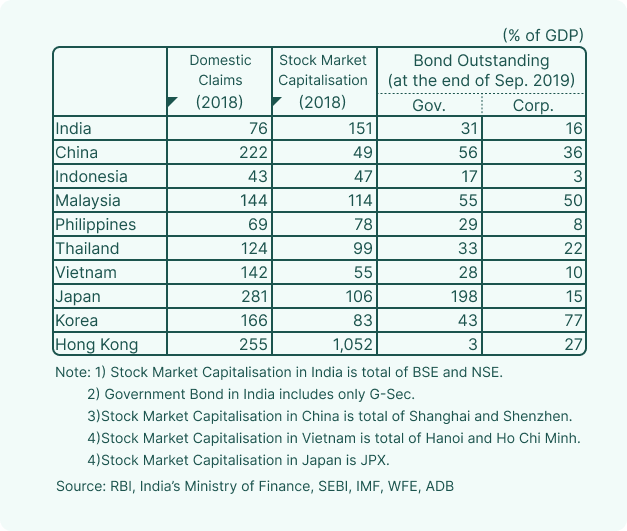
The trends in East and South East Asia follow a strikingly similar path, as demonstrated in Figure 1 above. The more advanced an economy, the more significant the proportion of its bond market relative to both its stock market and GDP. Notably, only Hong Kong deviates from this trend mainly due to its unique position as a financial center bridging the East and the West. Boasting the highest GDP per capita figures, Japan and Korea have two times larger bond markets than their stock markets. After them, China and Malaysia follow with their relatively developed bond markets, corresponding to their relatively higher GDP per capita. With its lowest GDP per capita figure, India has the lowest bond market capitalization to stock market capitalization ratio. Consequently, its stock market capitalization as a percentage of GDP stands at 151% whereas its bond markets combined stands at only 47%.
1 - https://www.weforum.org/agenda/2024/03/oecd-government-bonds-and-other-economic-stories-to-read/
2 - https://www.sifma.org/resources/
Share of Debt as a Percentage of GDP
On top of the composition of capital markets, advanced economies differ from emerging markets in terms of their level of indebtedness.
The evolution of capital markets, as we recognize them today, began in the late 13th century, marking a pivotal moment in political and economic history. By the late 17th century, absolute monarchies were debilitated, republics were rising, and subjects were asserting their rights as citizens. Under these evolving economic and political conditions, the concept of government debt gained momentum.4 5 States began offering interest in exchange for the citizens entrusting them with their money —a far more advantageous arrangement than imposing burdensome taxes.
Today, governments still need financing, often not to conquer other lands but to improve their infrastructure and fund welfare programs that disperse wealth to all strata of society. Raising taxes irresponsibly is still a bad idea, and tapping capital markets works wonders.
The ability to raise funds quickly from a willing group of people changed the world in so many ways. Fundamentally, this ability is the reason for the world order we know. Over 500 years, starting from the 1500s, global productivity per capita, representing the production of goods and services, surged by an impressive 1600%, soaring from $550 to $8800.6 Europeans until the late middle ages had little to show for themselves. However, as the inventors of capital markets, they could wage wars and innovate through science at such an unprecedented rate that it gave them a massive upstart at the beginning of the modern era.
With capital markets in their arsenal, European corporations and governments conquered the world. With each conquest, they could repay their loans, bolster investor confidence, and secure more borrowing, perpetuating a cycle that left underdeveloped regions further marginalized. Digressing a bit, this dominance led to a sense of superiority and the development of flawed theories such as scientific racism, as well as the commencement of the Atlantic slave trade, entrenching the disparities they had initially created.
However, human history is characterized by evolving world orders and shifts in global power dynamics. While some countries managed to catch up with European powers and even surpass them, today’s emerging markets remain largely excluded from the debt market. The current financial system, failing to include emerging markets, is inadequate for levelling the playing field and ensuring global prosperity for all.
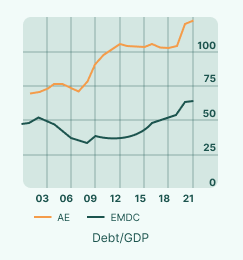
As depicted above in Figure 2, the overall indebtedness as a percentage of GDP stands approximately twice as high for advanced economies (AE) compared to emerging markets and developing countries (EMDC). Even though a proper country-specific analysis would require dozens, if not hundreds, of pages of writing, Figure 3 from 2022 below provides a general overview of the tendencies of indebtedness across individual countries.
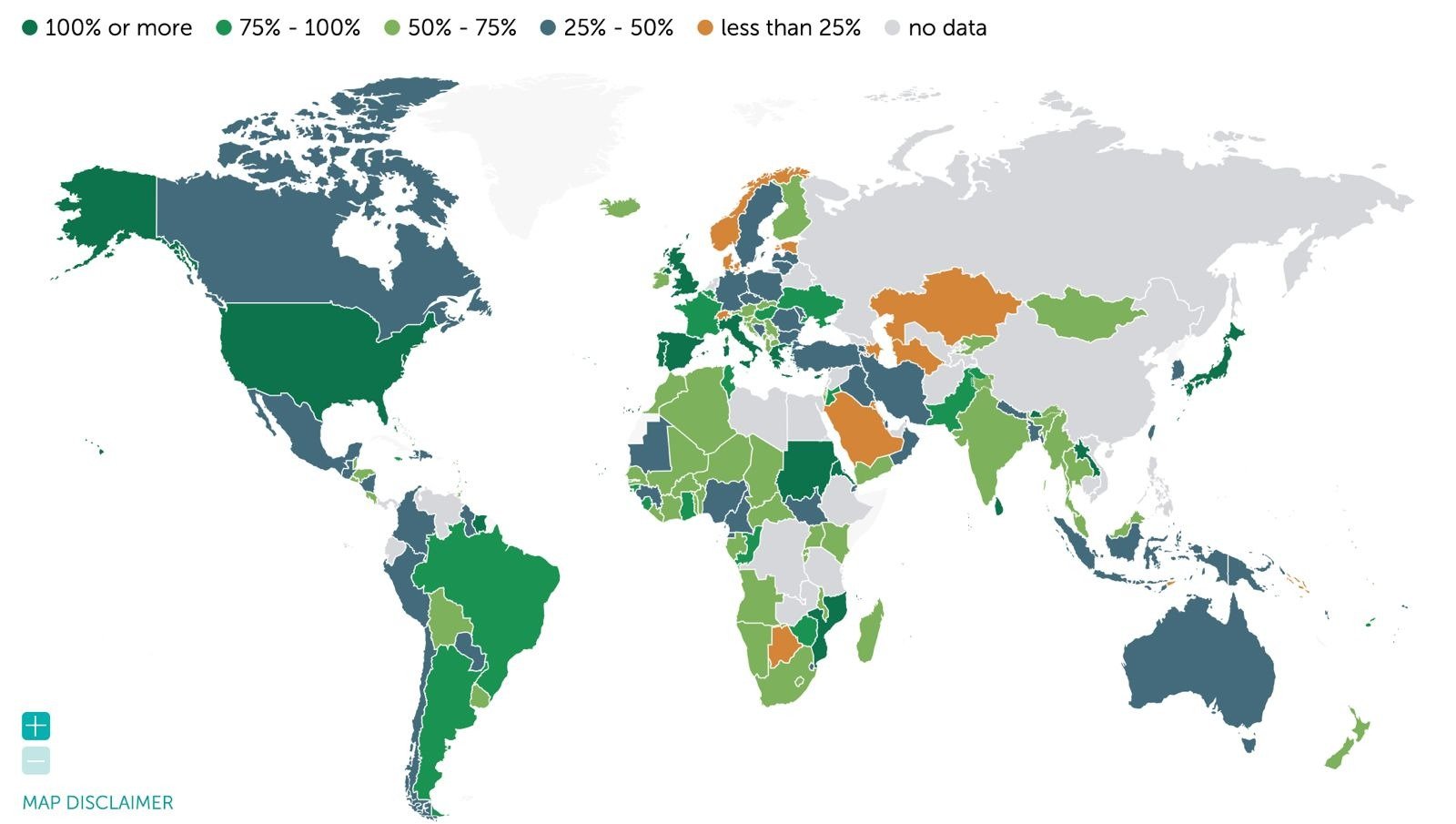
Figure 3 from https://www.imf.org/external/datamapper/CG_DEBT_GDP@GDD/CHN/FRA/DEU/ITA/JPN/GBR/USA
As expected, advanced economies like the US, Japan, and much of Western Europe showcase significant indebtedness. Even though there are various and country-specific reasons for many outliers, some, like Canada, Norway, Saudi Arabia, and Chile, defy this trend with lower-than-expected debt-to-GDP ratios relative to their income per capita levels, often attributed to their reliance on natural resources for achieving high-income status.
Notably, Africa also presents a contrasting picture. Despite not matching the indebtedness levels of advanced economies, many African countries exhibit high debt-to-GDP ratios relative to their income per capita levels. This situation arises from a combination of two major factors. First, African governments often struggle to effectively utilize borrowed funds for essential infrastructure and welfare programs. Second, the corporate bond market in Africa is significantly underdeveloped, not only in comparison to advanced economies but also relative to other emerging markets. This underdevelopment limits support for private enterprises and hinders economic growth.
5 - https://www.thinkadvisor.com/2009/02/01/the-earliest-securities-markets/
Share of Corporate Bonds in the Overall Debt Market
As discussed, productivity per capita stagnated for much of history, leaving the majority of people without hope for a better tomorrow. Along with other barriers, the inaccessibility of credit excluded most of the population from entrepreneurial ventures.
The invention of joint-stock companies, at least as important as government funding, came along with the development of capital markets. These developments enabled entrepreneurs to raise funds easily and establish flourishing businesses. However, in some cases, debt issuance was preferred instead of selling shares, giving rise to the need for corporate bonds.
Today, the deep capital markets of advanced economies tout a healthy balance between corporate and government bonds, whereas emerging markets lag significantly in the issuance of corporate bonds. As exploring this imbalance is crucial to understanding Bondi’s vision, we have covered the region-wide figures in "Exploring the Bond Market" and provided further insights into how this imbalance adversely affects retail accessibility in “Unlocking Retail Potential".
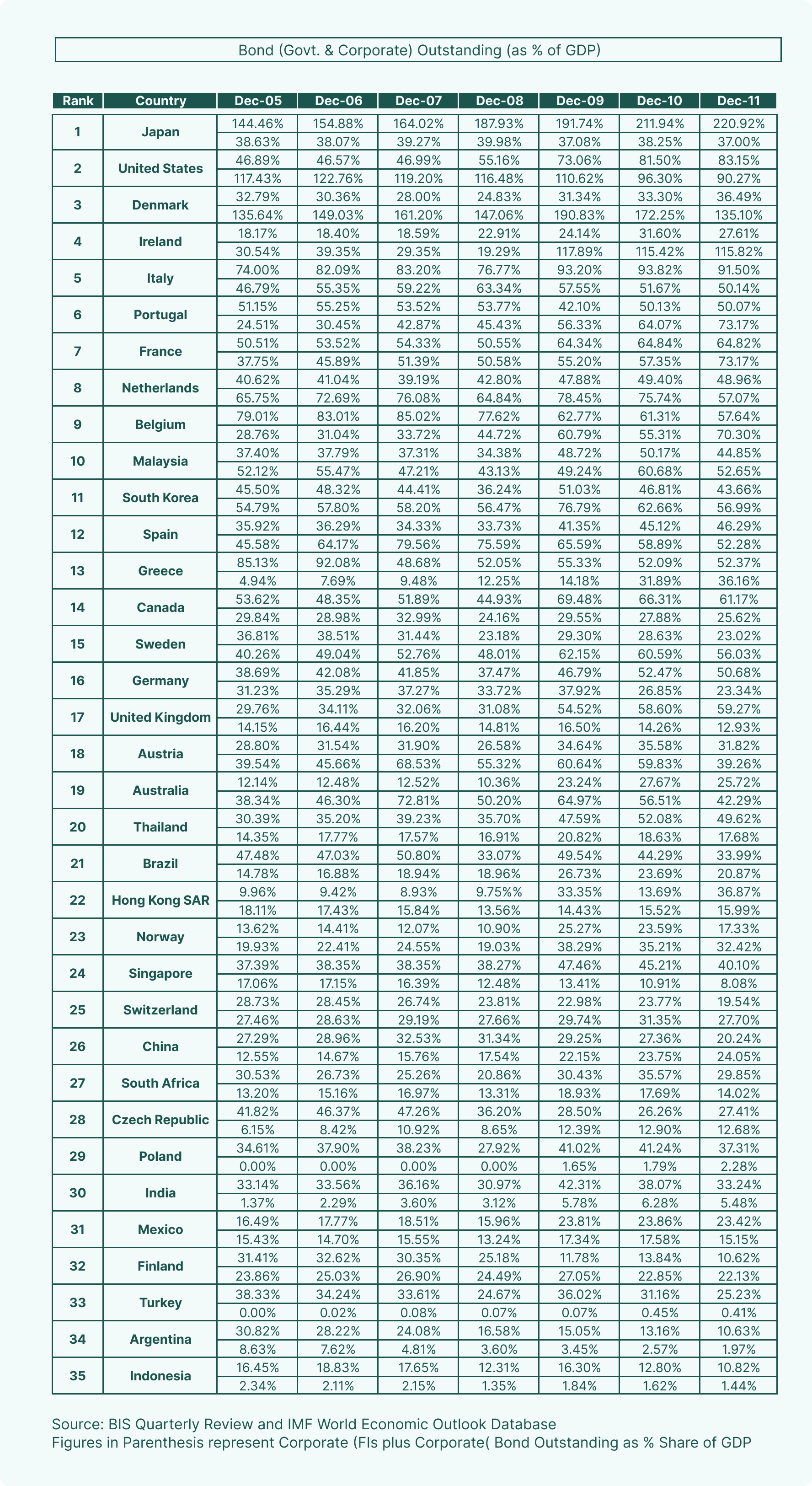
Figure 4 presents a broader view by including a greater number of countries, highlighting the trends discussed above. Despite some exceptions and specific reasons for these outliers, it is observed that local corporate bond markets thrive where the currency is stable.
Notably, some emerging market countries like Malaysia, Thailand, and China, although still lagging behind advanced economies, have managed to build deep corporate bond markets. In 2012, the corporate bond market to GDP ratios were 57.05%, 17.68%, and 24.05%, respectively. This success is attributed mainly to the confidence instilled by their currency stability against the dollar.
In contrast, countries with weaker currencies that lost around 50% or more of their value against the USD in the last 20 years, such as India, Turkey, Argentina, and Indonesia, had extremely weak corporate bond-to-GDP ratios of 5.48%, 0.41%, 1.97%, and 1.44% respectively in 2012.
Similarly, as a region, Africa, being the world’s least developed region and plagued with soft currencies, had an average amount of outstanding corporate bonds at just 1.8% of GDP.7
It would take decades of structural policies rigorously applied for these countries to develop a robust local bond market. However, the world is developing at unprecedented speed, and corporate bonds are essential for growth, as emphasized.
Therefore, firms in these countries and regions with soft currencies tap the offshore markets and issue foreign exchange-denominated bonds, which is the first offering of Bondi. To understand these bonds better, we delver deeper into them in our article "The Advantages of USD Denominated Bonds for Companies”
Consequently, there must be foreign investors willing to invest, and while there are, their participation also shows disparities between advanced and emerging markets.
Share of Foreign Holders
The 21st century is characterized by globalization; the world is becoming more and more interconnected, borders are getting flurry, and capital is looking for new horizons to explore. Capital is plentiful on a global scale, and the significance of accessing foreign capital cannot be overstated.
Foreign investors have provided a significant development impetus to numerous markets. Although they are often viewed as a source of capital, foreign investors often serve as catalysts for broader developments.
Foreign investors play a crucial role in enhancing price discovery, boosting demand for longer-maturity instruments, providing liquidity, reducing borrowing costs, and exerting pressure for enhancements in fiscal policy. According to Asonuma et al. (2015), the phenomenon of "home bias", where domestic banks hold domestic sovereign debt, may be linked to less adaptive fiscal policies or increased borrowing costs during periods of crisis.8 9
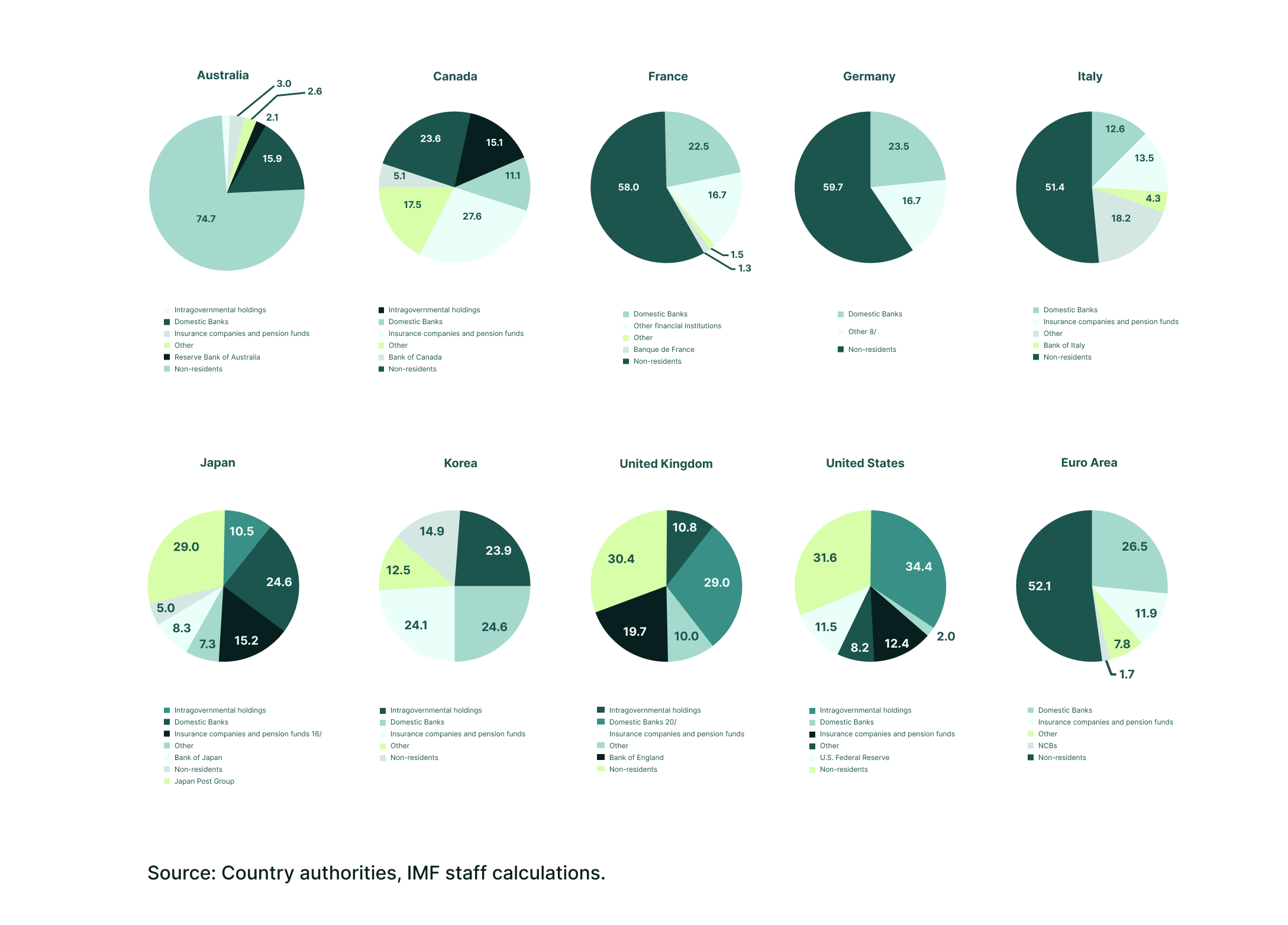
Figure 5 shows the composition of the investor base of government securities for 2011 or the latest period available. Even though the pie charts reflect region or country-specific patterns, overall, they highlight the heightened share of non-resident (foreign) investors and the diversified investor base in advanced economies.
Canada, the United Kingdom, and the United States, countries with very deep financial markets and highly developed financial systems, exhibit a diversified investor base with significant holdings by all investor types. European countries (and Australia) show deep ties with non-resident investors. In contrast, Japan and Korea have a very low share of non-resident holdings.10
Further analysis is required to explain the country-specific differences. However, it could be speculated that low participation by foreign investors is a factor explaining the low share of corporate bonds in Japan and the overall relative shallowness of the Korean debt market.
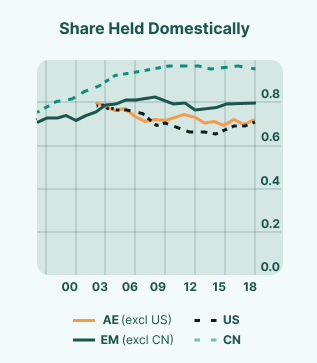
Unfortunately, debt markets in advanced and emerging economies also differ by the share of foreign actors in government bonds being around 15% higher, as shown below in Figure 6.
On top of having fewer foreign investors compared to other emerging markets, Africa, being the world’s least developed region, sees its bond market dominated by banks. By the end of 2019, banks held an 81.2% share of outstanding government bonds in the West African Economic and Monetary Union (WAEMU) zone, a trend similar across sub-Saharan Africa. These bonds are primarily used for refinancing by the Central Bank (BCEAO), which results in insufficient funds circulating to generate transaction activity in both the secondary and primary markets.11 This dominance by banks also leads to higher borrowing costs for African governments, a phenomenon we discussed in our previous article, “Unlocking Retail Potential".
Consequently, Africa stands to benefit even more disproportionately than other emerging markets from increased foreign investor participation.
Conclusion
The disparities in financial depth between advanced and emerging economies continue to shape global markets. Democratizing finance is key to addressing this gap, as increased access to capital markets empowers emerging economies to grow and prosper. Through globalization, foreign investors play a crucial role in dispersing wealth and providing the capital needed for development.
Bondi Finance contributes to building this transformation one brick at a time. Starting with tokenizing emerging market corporate bonds, Bondi is laying the groundwork to become a tokenization engine for a wide range of financial instruments, supporting a more inclusive global financial system.
More from the blog.
All posts
The Reinvestment Vault: How coupons become more bonds
Coupons are the whole point of a bond and the one thing DeFi cannot handle. The Reinvestment Vault keeps the Bond Token a full bond underneath and puts a clean, compounding ERC-20 share on top:…

Introducing the Redemption Vault: From request to cash
A Bond Token keeps everything a bond does, so its exit has to handle everything a bond does. The Redemption Vault gathers exits of any size into one real bond sale through the regulated custody…

Introducing v3: Every change to the Bondi core, and why
Bondi v3 is built on the v2 contracts and closes the gap between a token that pays coupons and a bond: calls, amortizations, a supply that grows, fees taken onchain, proceeds that never pass through…