

Unlocking Retail Potential
Democratizing financial markets means opening their potential to every day investors. Retail investors had been stuck between equity investments and low-yield savings accounts due to difficulty accessing the debt markets and financial illiteracy.
The global bond market is a sizeable portion of the global debt securities market, and it stood at around $100 trillion in 2023, similar in size to both global equity markets and the global GDP.1 This article discusses the benefits of retail participation, policies and obstacles influencing such participation, and the retail demand.
Benefits to Retail Participants
Retail participation in bond markets has been steadily increasing, and for good reason. Bonds offer numerous advantages over traditional bank deposits and equity markets for both risk-averse and high-yield seeking retail investors, making them an attractive option.
Below, we will compare corporate bonds to bank deposits and equities in terms of their benefits for retail investors. The advantages of corporate bonds for businesses compared to other alternatives are discussed in our article, “What Makes Corporate Bonds So Important?”
Comparison with Bank Deposits
An established bond market is an excellent route for directing investor money towards capital formation.
The equity market fails to capture a significant segment of individual investors due to its inherent volatility. Typically, savers prefer parking their savings in different deposit schemes by banks and other financial institutions, especially in emergent economies such as India.2 These deposit schemes, like savings accounts, are known as safe places to put your money. However, as even the safest bonds, the ones considered as “riskless” in finance, pay around one point five times to two times more than the bank deposits3, it is expected that risk-averse retail investors would invest in bond markets under the right conditions.
Unfortunately, risk-averse retail investors still have little access to the bond markets, leaving them with little choice but to use bank savings accounts, which frequently produce returns less than inflation. It would be beneficial to promote a mindset among individual investors that their funds should be allocated to fixed-income products instead of just being deposited in bank accounts.4
1 - https://www.weforum.org/agenda/2024/03/oecd-government-bonds-and-other-economic-stories-to-read/
3 - https://www.eastspring.com/insights/vietnam-corporate-debt-market-fast-growing-promising
4 - ASIFMA Paper: India Bond Market Roadmap - October 2013
Comparison with Equity Markets
There are major differences between equities and debt securities. Equity investments, like stocks, are riskier investments in nature. There are no periodic payments and no guarantees of preserving investors’ capital. Bond investors know that they will be receiving a periodic fixed income along with their principal when the bond matures, as long as the company does not go bankrupt and default on its debt. Also, in the case of bankruptcy, bond investors are prioritized over equity investors.
High-yield seeking retail investors can find significant opportunities in corporate bonds. These bonds offer higher returns than government bonds, catering to investors looking for greater income potential while still benefiting from the relative stability and predictability that bonds provide over equities.
Periodic coupon payments, a known return day for their invested principal, and priority in case of bankruptcy would be very attractive for retail investors.
Due to these factors, advanced economies already have a well-established high retail participation in bond markets. For example, the US corporate bond market boasts a broad investor base of both domestic and foreign retail investors.5 The lack of a developed bond market creates friction to enable retail access.
Bonds in Advanced Economies versus Emerging Markets
There are significant differences between the capital markets of advanced and emerging economies. While our article, "Market Structure and Financial Depth Disparities Among Countries", covers these differences extensively, we'll now dive into related key details that impact retail investors.
Generally, advanced economies have similar portions of their GDP as bank deposits, equity markets, and debt markets, whereas emerging markets are significantly more concentrated in the riskier equity markets, which negatively impacts the health of capital formation.
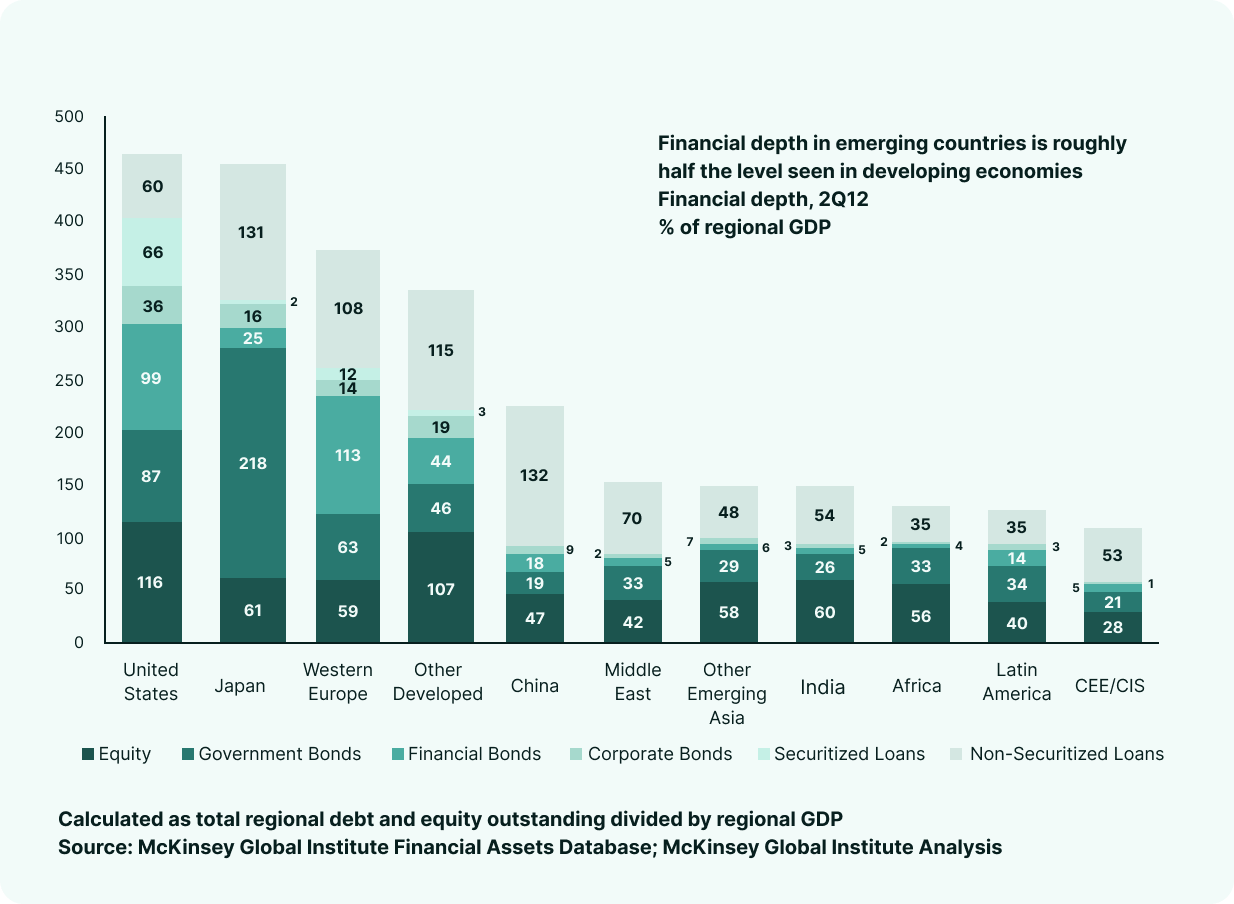
Figure 1 from ASIFMA Paper: India Bond Market Roadmap - October 2013
The table shows that as of 2012, the US and other developed economies had 126% and 118% of their GDP in securitized and non-securitized loans, respectively. Note that due to fractional reserve banking, it is not fully true that these correspond equally to bank deposits, but it is still important as it alludes to the involvement of bank loans and deposits in the economy. Additionally, the equity markets represented 116% and 107% of GDP, while bond markets accounted for 222% and 109% of GDP.
On the other hand, bank loans relative to the GDP represented 54% in India, 48% in other emerging Asia, and 35% in Africa, compared to 60%, 58%, and 56% for equity markets and 34%, 42%, and 39% for bond markets. Despite bond markets being more aligned with bank loans in these emerging markets, they lag behind equity markets by about 40%.
Moreover, a stark difference appears when the composition of the bond market is analyzed. As we discussed in our first article, “Exploring the Bond Market", government bonds, compared to corporate bonds, constitute a significant portion of the bond market in emerging markets. In the US and other developed economies, bonds, excluding government bonds, accounted for 135% and 63% of GDP, respectively. In contrast, in India, other emerging Asia, and Africa, bonds excluding government bonds represented only 8%, 13%, and 6% of GDP, respectively.
The government bonds tend to be owned mostly by financial institutions or banks and typically offer lower yields. Therefore, high-yield seeking investors are less likely to be enticed by these bonds. Consequently, high-yield-seeking investors turn to equity markets instead.
Financial depth differences hinder retail participation, leading them to less optimal alternatives like equity and bank deposits. However, having retail access would benefit the bond markets, likely making their composition healthier, as seen in advanced economies.
For example, in India, the lack of retail investors is considered a major factor for corporate bond market's inadequate growth.6
Benefits to Bond Markets from Expanded Retail Participation
The inclusion of a broader retail investor base brings several advantages to the bond markets:
- Levelling the Playing Field: Increased retail participation contributes to a level playing field, aligning domestic markets closer to international standards. This not only enhances market efficiency but also attracts foreign investment, further strengthening the bond market.
- Democratization: Greater retail participation broadens the investor base, making the market less dependent on institutional investors and reducing the risk of market manipulation. Democratization provides issuers with a more stable and diversified source of funding.
- Capital Flows: As discussed in our prior article, “Financial Inclusion and the Role of Tokenized Bonds", and shown by empirical evidence, increasing financial inclusion and developing the bond markets in emerging economies will increase capital flows.7 This means increased liquidity and a bigger pool of funding for corporations.
- Higher Absorption Rates and Less Impact on Yields: Private investors, such as retail investors, have shown an appetite for the bond market, even at lower yields than banks. Research by the Bank for International Settlements, covering 95 countries over 20 years, shows that non-bank private investors increase their sovereign debt holding at significantly higher rates than any other group. For instance, when there is an increase in debt, 69% is allocated to non-bank investors, even though they make up only 46% of holdings on average. More strikingly, it is shown that a 10% increase in debt corresponds to a 6.7% increase in yield for the average EM borrower. However, if non-bank investors are not present and borrowers must borrow from banks, the same 10% increase in debt corresponds to a substantially higher 9.1% increase in yield.8 9
Considering the benefits to retail investors and the bond markets alike, emerging countries’ governments are currently trying to increase awareness and participation of retail investors in debt securities.
Policy for Retail Participation
Regulators and policymakers have recognized the importance of enhancing retail participation in bond markets.
Governments in East Asian countries have made concerted efforts to increase retail access to government securities, promoting a better asset mix in investor portfolios.10 In Thailand, for example, the Capital Market Development Plan (2019–2021) aims to increase retail participation in the bond market.11 Similarly, the Governor of the Reserve Bank of India emphasized the need to boost retail adoption of corporate bonds in October 2015.12
Several positive policy developments have been implemented to facilitate retail participation in bond markets in other parts of the world as well. For instance, in Turkey, income tax on earnings from corporate bonds with maturities longer than four years has been eliminated for individuals and foreign investors. For corporations, this tax has been reduced to 15%.13
Historically, and continuing to this day, bond markets have had high minimum investment amounts for purchasing a single bond. Since retail investors have limited savings and need to diversify their investments to mitigate risk, the minimum entry amounts have been a barrier to retail access.
In 2022, The Securities and Exchange Board of India (SEBI) has reduced the minimum face value of listed debt securities under private placement from ₹10 lakh to ₹1 lakh (~$12.000 to ~$1.200), making bond investments more affordable for retail investors.14 Similarly, in the Philippines, Retail Treasury Bonds (RTBs) are issued in smaller denominations with frequent fixed-rate coupon payments, catering specifically to the retail market. In April 2010, the government of the Philippines also introduced the Multicurrency Retail Treasury Bonds, allowing Filipinos to invest in foreign-currency-denominated government securities at affordable minimum denominations.15
Despite these efforts, significant obstacles still hinder retail participation in bond markets.
11 - https://www.cgif-abmi.org/storage/2021/09/Thailand-Corporate-Bond-Market-2020.pdf
Remaining Obstacles for Retail Participation
Financial illiteracy is a major problem for retail investors. Considering that the bond market offers opportunities for both risk-averse and high-yield seeking investors, it seems likely that retail participants do not fully understand the concept of risk and return in the bond market.16
Other significant barriers for retail investors include difficulty trading due to lack of liquidity, a high portion of bonds reserved for private placement, and information asymmetry, in addition to the inconsistent tax burdens and large lot sizes discussed above that policymakers are trying to improve.
For example, in the Indian corporate bond market, poor liquidity in secondary markets and inconsistent tax burdens on interest income deter retail investors, even those ready to take the risk to generate higher returns.17
Information asymmetry refers to the lower accessibility of pre-trade and post-trade information for retail investors. This lack of transparency can leave retail investors at a disadvantage, as seen in cases like the Parmalat scandal, where institutional investors suspected financial problems and liquidated their positions, leaving uninformed retail investors exposed to higher risks and lower prices if they preferred getting out.18 To the disadvantage of retail investors, the doubts of institutional investors were not incorporated into the asset price due to opaque trading practices like OTC trading.
Trading and Liquidity
In markets like the People's Republic of China, the bond market is split between an exchange bond market and an inter-bank bond market. The exchange bond market primarily caters to retail and small to medium institutional investors, including foreign investors. On the other hand, the inter-bank bond market is for big institutional investors where one-to-one quote-driven trading takes place. Shockingly, in 2012, the inter-bank bond market accounted for about 94% of outstanding bond value and 99% of bond trading volume, limiting retail access to liquidity and trading opportunities.19
Private Placement, Minimum Denomination Amounts, and High Net Worth Individuals
Private placement in the context of bonds refers to the selling of bonds directly to a select group of investors rather than through a public offering. Even though private placement bonds can be easier to issue as they can offer more customizable terms and have fewer regulatory requirements, they limit retail access to the bond markets.
The common practice in advanced economies is to proceed with public issues whereas private placements play a major part in emerging markets. In Vietnam and India, approximately 90% to 99% of the existing bonds are issued through private placements. However, private placements accounted for only 12% in the USA, 10% in Germany, and 0.4% - 15% in South Korea.20 21
Despite this extremely high concentration of private placements, on 16 September 2022, the Vietnamese government passed Decree 65/2022/ND-CP, which further tightened the requirements for investors to buy privately placed corporate bonds. In response to some bad faith issuers from the property sector, the minimum denomination of bonds was increased from VND 100,000 (~$4) to VND 100 million (~$4,000). Moreover, Decree 65 stipulated that only individual investors with a portfolio value of at least VND 2 billion (~$80,000) are eligible to purchase privately placed corporate bonds.22 With the wealthiest 1% of Vietnamese having a net worth of approximately $160,00023, these regulations, despite aiming to protect retail investors from financial losses, effectively exclude nearly all retail investors from accessing high-yield bond markets. Consequently, they are forced into either riskier equity markets or bank deposits that yield below the rate of inflation.
In contrast, India, as discussed above, reduced the minimum denomination of bonds under private placement from ₹10 lakh to ₹1 lakh (~$12,000 to ~$1,200), with the denomination of public issues already set at a welcoming ₹1,000 (~$12) per bond. However, this seemingly positive development obscures the actual reality. SEBI's 2022–23 Annual Report states that 98.79% of the debt raised in India during FY 23 came from private placements, while public issues were only 1.21%. This indicates that most of the bond supply is priced at ₹1 lakh (~$1,200). In developed economies, ₹1 lakh might not seem like a lot of money to the typical retail trader, but this isn't the case in India. If a young to mid-aged Indian investor allocated 20% of their portfolio to diversified bonds consisting of at least five bonds, this would imply a portfolio of ₹25 lakh (~$30,000), of which ₹5 lakh (~$6,000) is dedicated to five distinct bonds. Based on the 2022–2023 ITR filings data, just 500,000 people, or a minuscule 0.035% of the Indian population, are estimated to be in the net income range of ₹25 to ₹50 lakh (~$30,000 to ~$60,000).
Therefore, due to the high concentration of private placements and high minimum denomination amounts, even the existing retail market is a high net worth individual investor market in most emerging markets.
Interestingly, in Turkey, the local corporate debt market is so highly dominated by high net worth individuals that even pension funds, insurance companies, and mutual funds are mainly absent.24 Most trading occurs between these wealthy individuals in OTC markets, leading to one-to-one, quote-driven pricing. This results in an inefficient and illiquid market where much information is lost and not incorporated into the prices.
Despite these obstacles, strong demand from retail investors shows that they are exceptionally well-suited for debt instruments.
20 - MB Securities Joint Stock Company, Vietnam Bond Market In the Readiness for Further Growth
23 - https://vir.com.vn/how-much-does-it-take-to-be-in-top-1-per-cent-of-vietnams-richest-85834.html
Retail Demand
As emphasized previously, bond markets cater to both risk-averse and high-yield retail investors for several reasons.
Despite household direct holdings being a negligible portion of government bonds25, they constitute a significant portion of corporate bonds, especially in certain countries. This indicates that high-yield corporate bonds have successfully attracted the right type of retail investors. In contrast, risk-averse retail investors have not yet fully recognized the potential benefits of holding government bonds.
Even though the composition of capital markets differs between advanced and emerging economies, the retail demand for the bond market is primarily country-specific rather than correlated with how developed an economy is.
Advanced Economy Demand
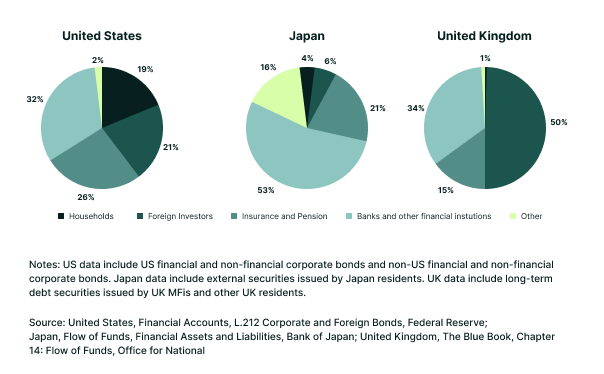
The pie charts above demonstrate the decomposition of holder types for corporate bonds in the USA, Japan, and the UK.
In 2013, households in the US directly held 19% of corporate bonds. However, this figure is misleading because households also invest in these bonds through bond funds like exchange-traded funds (ETFs). The Royal Bank of Scotland estimated that, including these indirect investments, retail holders actually owned about 37% of corporate bonds. Interestingly, the portion of equity investments directly held by retail investors was also 37%. This highlights the depth of the US capital markets and the significant role retail investors play compared to emerging markets and other advanced economies.26
In Japan, households held only 5% of the total outstanding amount of corporate bonds at the end of 2013. Similarly, in the UK corporate bond market, direct retail participation was almost non-existent, around 1.5%.
Nevertheless, individual investors' direct holdings vary significantly between advanced economies. In Italy, individual investor holdings of bonds comprise 20% or more of total financial holdings. In Germany, the equivalent percentage is between 10% to 15%, and in other countries, it will typically be a tad lower than 5%.27
Emerging Market Demand
A survey by IOSCO (2011) on corporate bond markets in 36 emerging market economies shows that the share of retail investors was 9% in 2010. This figure is even higher than many of the advanced economies.28
In Vietnam, by 2018, individual investors had been making a presence and sharing an important part of the total corporate bond market; estimates indicate that they may have accounted for 10-15% or more of the total corporate debt market.29
In the first nine months of 2022, individuals, mostly mass retail investors, bought a staggering 31% of newly issued bonds, behind only banks with 44%, according to data from the Hanoi Stock Exchange.30
More recently, in October 2023, The Philippines raised $1.3 billion from a sale of dollar bonds targeted at individuals, attracting significant demand from retail investors through online platforms.31
However, there are failures, too. Indian Regulatory Bodies have not had the same success they had with the equity markets in enhancing retail access to the bond markets. Indian corporate bond markets fail to have a retail investor base and Indian retail investors, despite being the biggest contributors of the country’s savings, are still torn apart between equity markets and savings schemes.32
One country stands out among the rest. Thailand is a unique country in regards to the continuous exposure of retail investors in the corporate bond market, surpassing both advanced and emerging markets. In 2019, individual investors were the most significant direct holders of corporate bonds, capturing a 31% market share.33
More interestingly, Thai retail investors, unlike all other investor groups, have no preference for tenor or issuer names and credit ratings. They invest as long as the yield is high.34
The overall lack of retail participation in government bonds, along with the specific situation in Thailand, indicates that bond markets currently cater mainly to high-yield seeking retail investors and fail to reach risk-averse retail investors.
29 - https://www.eastspring.com/insights/vietnam-corporate-debt-market-fast-growing-promising
30 - https://www.ifre.com/story/3834848/vietnam-eases-bond-measures-whnzg5jqgy
33 - https://www.cgif-abmi.org/storage/2021/09/Thailand-Corporate-Bond-Market-2020.pdf
34 - https://www.cgif-abmi.org/storage/2021/09/Thailand-Corporate-Bond-Market-2020.pdf
Conclusion
Bondi envisions a future where the needs of various retail investors with different risk tolerances are met through tokenization. We are starting with high-yield corporate bonds in emerging markets, recognizing the clear market fit and their absence in the current state of RWA tokenization. But this is just the start!
Bondi will tokenize all types of existing bonds, directly issue bonds for firms with obligations paid from revenues onchain, and then tokenize other financial instruments, even providing opportunities to insure against bond bankruptcies.
With blockchain, Bondi will overcome all existing obstacles and democratize bond markets worldwide, bringing and tokenizing all RWAs onchain to serve the masses.
More from the blog.
All posts
The Reinvestment Vault: How coupons become more bonds
Coupons are the whole point of a bond and the one thing DeFi cannot handle. The Reinvestment Vault keeps the Bond Token a full bond underneath and puts a clean, compounding ERC-20 share on top:…

Introducing the Redemption Vault: From request to cash
A Bond Token keeps everything a bond does, so its exit has to handle everything a bond does. The Redemption Vault gathers exits of any size into one real bond sale through the regulated custody…
Introducing v3: Every change to the Bondi core, and why
Bondi v3 is built on the v2 contracts and closes the gap between a token that pays coupons and a bond: calls, amortizations, a supply that grows, fees taken onchain, proceeds that never pass through…